
Cat care · Grooming at home
Cat Grooming: Does Your Cat Need Your Help?
Most cats keep themselves clean. But a long coat, stiff joints or a few extra pounds can get in the way. Here’s when your cat needs a hand, and when to call a groomer or your vet.
Quick answer
Most healthy cats do a good job grooming themselves, but nearly every cat benefits from regular brushing. Long-haired cats usually need it daily, or at least every few days, to keep mats from forming. Older, arthritic and overweight cats often can’t reach everywhere anymore, so they need more help. Brushing also means less swallowed hair and fewer hairballs. And if a mat won’t brush out, don’t reach for the scissors. A groomer or your vet can clip it out safely.
At a glance
“You mean I have to groom my cat, too?” It’s a fair question. Cats spend so much of their day licking their coats that it’s easy to assume they have it covered.
Most of the time, they do. But I trained as a veterinary technician before I ever started pet sitting, and I still look at a cat’s coat the way a vet tech would. A coat that’s greasy, dull, clumped or matted is often a sign that something is getting in the way of your cat’s usual routine. Here’s what to look for and how to help.
The basics
Do cats really need grooming?
Yes, even though cats come with their own grooming kit. The ASPCA points out that a cat’s tongue and teeth handle most of her hair care, and VCA notes that most healthy adult cats rarely need a bath.
Brushing does things a tongue can’t. VCA Animal Hospitals notes that regular brushing removes loose hair and dead skin cells, keeps dirt and parasites out of the coat, and spreads the skin’s natural oils along the hair. For short-haired cats, the ASPCA suggests one or two brushings a week, and says regular sessions matter even more as a cat ages and can’t groom as carefully on her own.
A sudden change in your cat’s coat is worth a call to your vet. VCA notes that a dull coat can be a clue to something else, like arthritis pain or extra weight that makes it hard to reach.
Who needs help
Which cats need extra help
Some cats need a lot more help than others. Here’s a quick way to tell where your cat falls.
| Cat | Why | What helps |
|---|---|---|
| Long or silky coat | Tangles and mats form fast, especially behind the ears, in the armpits and along the back legs (VCA) | Brushing daily, or at least every few days |
| Senior cat | Cornell says older cats groom less effectively, which can lead to matting, odor and skin inflammation | Gentle, regular brushing, plus a vet check if the coat changes |
| Overweight or arthritic cat | Joint pain or extra weight can make some spots hard to reach (VCA) | Help with the back, belly and hind end; ask your vet about joint pain |
| Heavy seasonal shedder | Cats in cooler climates may go through two big sheds a year, in late spring and late fall, especially cats who go outside (VCA) | Extra brushing during shedding season |
That last one fits Connecticut. If your cat suddenly leaves a layer of fur on the couch every spring and fall, that’s probably why.
Hairballs
Brushing and hairballs
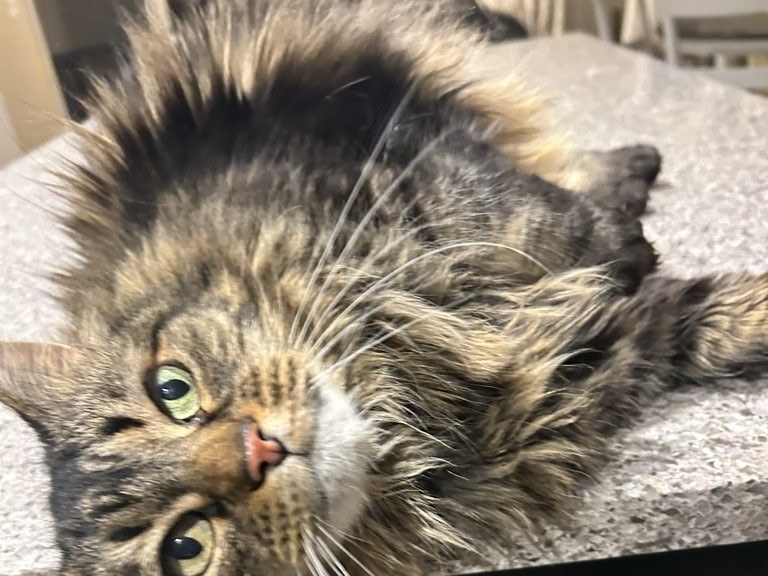
A cat’s tongue is covered in tiny backward-facing hooks. Cornell’s Feline Health Center explains that those hooks push loose hair down the throat as a cat grooms. Most of it passes through, but some can build up in the stomach into a hairball.
Long-haired breeds like Persians and Maine Coons are at much higher risk than short-haired cats, and hairballs tend to show up more in shedding season. Cornell’s first tip for cutting down on them is simple: get your cat used to daily brushing and combing. Every bit of hair on the brush is hair your cat doesn’t swallow.
Cornell says a hairball every week or two is common and usually nothing to worry about. Call your vet right away if your cat is lethargic, won’t eat for more than a day or so, or keeps retching without bringing anything up. Hacking can also be a sign of something else, like asthma. Read more in our post on cat hairballs.
At home
How to brush your cat
Before you start, take a look at the coat. The ASPCA says a healthy coat has a natural shine and springs back when you touch it, with no bald patches, fleas or ticks, and no wounds or unusual bumps on the skin.
- Short coats: Work a metal comb through the fur from head to tail, in the direction the hair grows. Do the chest and belly too, one section at a time. A rubber brush is great for pulling out loose short hair.
- Long coats: Start with the belly and legs, gently combing the fur up toward the head. Comb the neck fur up toward the chin. For the tail, part the fur down the middle and brush out each side.
- Feel as you go: Run your hands over your cat’s body to find wounds, bumps and hidden tangles. Look for flea dirt, the black specks fleas leave behind.
- Check the back end: Peek under the tail for anything stuck in the fur. Long-haired cats can get messy back there.
- Be gentle: VCA says not to pull hard on tangles. Your vet team can recommend a brush or comb that suits your cat’s coat.
My own two cents: short and pleasant beats long and stressful. A few calm minutes with a cat who’s enjoying it does more good than one big wrestling match.
Mats
Mats: put down the scissors
Mats aren’t just a looks problem. An ASPCA veterinarian explains that mats are very uncomfortable, can irritate the skin and turn into infected sores, and can trap feces around a cat’s back end. Fleas and ticks can also hide deep inside them.
Small, early tangles can often be brushed or combed out gently. But please don’t cut a mat out with scissors. Mats sit close to the skin, and a cat can jerk or twist at the wrong moment. The ASPCA warns this can cause a severe cut or puncture, and VCA says to use only clippers on mats, never scissors.
If a mat won’t brush out, take your cat to a groomer or your vet. They can clip it safely. A cat with a lot of mats may need sedation and a full clip, so it’s worth catching them early.
Getting help
When your cat won’t let you
Some cats simply won’t tolerate grooming. The ASPCA’s advice: if your cat fights it and someone could get hurt, make an appointment with a professional groomer or your vet instead.
Cornell suggests that if a cat won’t allow daily brushing, a haircut from your vet or a reputable groomer once or twice a year can help, especially for long-haired breeds. One option is the “lion cut.” VCA describes it as trimming the body short while leaving the hair long on the face, feet and tip of the tail. Some cats need sedation for it, since few cats like the clippers. Your vet can tell you if it makes sense for your cat.
We’re pet sitters, not groomers. To find someone local, see our groomer referral list. It includes a salon in Meriden that grooms cats as well as dogs.
Cat sitting
While you’re away
When we care for your cat at home, a visit is more than food and the litter box. Company can mean play, brushing, lap time, or a polite hello from across the room for the shy ones. Your cat sets the pace.
If your cat enjoys being brushed, tell us at your meet & greet and leave the brush where your sitter can find it. You can read more about how our cat sitting visits work, or see how to care for your cat while you’re away.
FAQ
Common questions
How often should I brush my cat?
For short-haired cats, the ASPCA suggests once or twice a week. Long-haired cats need more: VCA recommends daily brushing for long, silky or curly coats, and the ASPCA says indoor long-haired cats need a session every few days.
Should I bathe my cat?
Usually not. VCA says most healthy adult cats rarely need a bath. An older or overweight cat who can’t groom well, or a cat who got into something messy, may need one now and then.
Is it okay to cut out a mat at home?
Not with scissors. The ASPCA and VCA both warn against it because it’s easy to cut the skin. Small tangles can be gently combed out. For anything bigger, see a groomer or your vet.
Our team is based in Cheshire and cares for cats at home in Southington, Wallingford, Hamden, North Haven, Meriden and New Haven. You can see the whole service area in one place.
Going away? Your cat stays home, brush and all
Tell us about your cat, grooming quirks included, and our office will reach out to set up your meet & greet.
Get Startedor call or text 203-439-0456
Sources (checked Nov. 25, 2026): ASPCA, Cat grooming tips; ASPCA, A haircut could save a life: preventing your pet’s coat from matting; VCA Animal Hospitals, Grooming and coat care for your cat; Cornell Feline Health Center, A hairy dilemma; Cornell Feline Health Center, The special needs of the senior cat. This post is general information, not veterinary advice. If your cat’s coat or skin changes, talk to your veterinarian.