
Dog Safety · Facts checked Nov. 2026
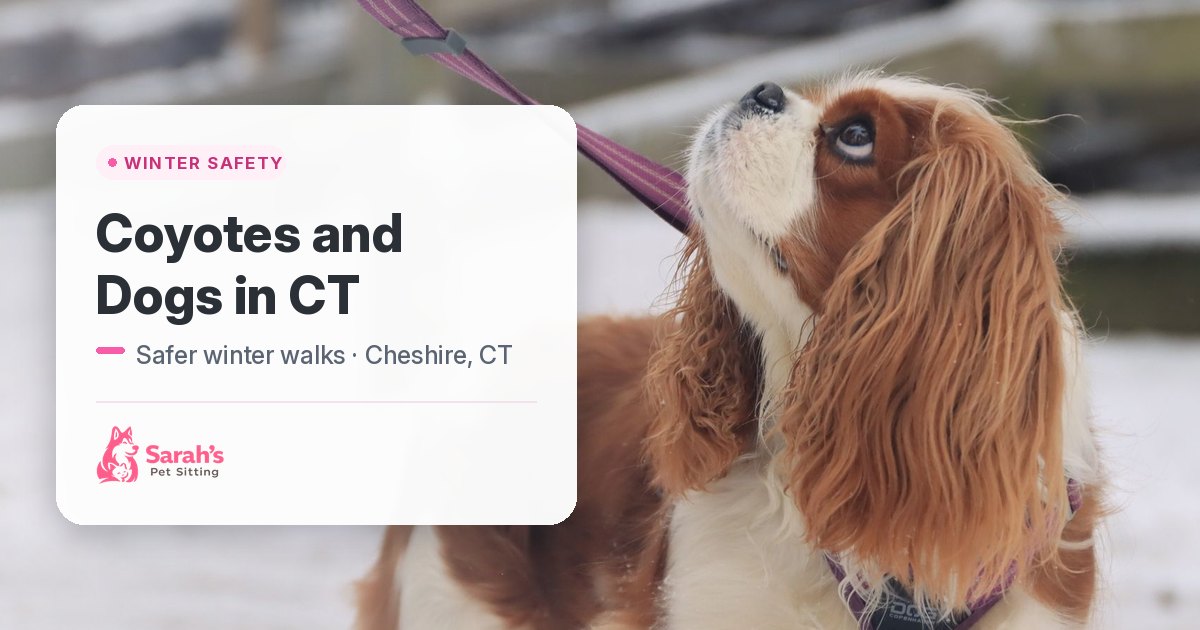
Coyotes and Dogs in CT: Keeping Your Dog Safe This Winter
Which dogs coyotes are most likely to bother, when they get bolder, and the simple habits that make dark winter walks and yard trips safer.

Quick answer
Coyotes live all over Connecticut, suburbs and parks included, and spotting one isn’t a reason to panic. CT DEEP, the state’s wildlife agency, says small dogs under 25 pounds and outdoor cats are the most at risk when they’re left unsupervised, and that coyotes can be more territorial toward dogs from January through May. Keep your dog on a short leash and stay with them outside, check the yard before you let them out early in the morning or at night, and feed pets indoors. If a coyote comes close, pick up a small dog or keep yours behind you, then get big and loud. Don’t run.
Winter changes dog walks around here. It’s dark early, the leaves are down, and coyote breeding season starts in January. If you’re wondering how coyotes and dogs in CT mix, I’d rather you feel prepared than nervous, so I read through what CT DEEP and Humane World for Animals recommend and pulled out what matters on an everyday walk or a quick trip out to the yard.
The basics
Are there coyotes in my neighborhood?
Probably. Coyotes are newer to Connecticut than you might think. DEEP’s coyote fact sheet says the first ones were reported in Connecticut in the mid-1950s, and now they’re found in every part of the state. They’re good at living near us, too: wooded neighborhoods, parks, beaches, even office parks.
Seeing one doesn’t mean something is wrong. DEEP’s Living with Coyotes page says coyotes are normally wary of people. The trouble starts when they get used to easy food, like birdseed, trash or pet food, and lose that fear. A coyote like that may approach a dog on a leash or follow people instead of running off.
Not sure what you saw? Picture a thin, leggy German shepherd. Most adult eastern coyotes weigh 30 to 50 pounds, with big pointed ears, a long narrow snout and a bushy tail that hangs low. DEEP says you’ll hear them most around dawn and dusk, and on a December evening that’s often right when we’re out with our dogs.
This isn’t just something I read about. My husband and I live in suburban Cheshire, and we hear coyotes outside our house almost every night. Coyotes aren’t only a woods thing. They’re part of ordinary neighborhoods.
Seasons
When do coyotes pay more attention to dogs?
Late winter into spring. In Connecticut, coyotes breed from January to March, and the pups are born from April to mid-May. DEEP says coyotes may be more territorial toward dogs during that mating and denning stretch, January through May.
Fall and early winter have their own pattern. That’s when last spring’s young leave their family to find a territory of their own, and DEEP notes some of them travel long distances to do it.
For bigger dogs, the risk is lower. Humane World for Animals (the group formerly called the Humane Society of the United States) says attacks on larger dogs are rare. When they happen, it’s usually because a coyote feels its territory is threatened, mostly during breeding season. Its prevention guide adds that a coyote may trail, or “escort,” a leashed dog walking near its den, and will usually back off once it’s clear you’re just passing through.
Small dogs
Which dogs are most at risk from coyotes?
Small dogs and cats who are outside on their own. DEEP’s fact sheet says unsupervised outdoor cats and small dogs, under 25 pounds, are the most vulnerable to coyote attacks in Connecticut. Its Living with Coyotes page explains why: coyotes may see cats and small dogs as prey, and larger dogs as competition.
So if your dog is a Shih Tzu, a Cavalier, a Yorkie or anything else you can scoop up with one arm, think twice about time alone in the yard, even a quick last potty break before bed. A big dog isn’t off the hook either, especially in late winter and spring.
If you have cats, DEEP recommends keeping them indoors, or outside only with you right there or in a secure enclosure.
On the walk
How do I walk my dog safely in coyote season?
- Keep the leash short. Humane World recommends a leash 6 feet or shorter, and says a coyote may treat a dog on a longer leash as if it were alone. Our post on choosing the best leash for your dog can help if you’re shopping for one.
- Stay right with your dog. DEEP’s rule of thumb: on a leash, with a person, every time they go outside.
- Bring something loud. A whistle or a small air horn is easy to clip on, and both DEEP and Humane World’s hazing guidelines list them as ways to scare a coyote off.
- Don’t let your dog chase or play with a coyote. Humane World is clear that dogs shouldn’t interact with coyotes at all.
- Plan around the dark. The Farmington Canal Trail is my favorite place to walk dogs in New Haven. The trail’s guidelines ask you to keep dogs on a short leash, and the trail is open dawn to dusk, so on short winter days I’d go earlier rather than squeeze in a walk after sunset.
On dark walks, I stick to lit streets. That’s not only because of coyotes. It’s just a good safety habit in general.
Our team does its best not to use retractable leashes unless that’s the only leash available. Sitters generally have a short 4-foot leash on hand.
Our walkers keep things simple: every walk is a leashed walk, we don’t take dogs to dog parks or dog runs, and dogs stay dry, so no wading into ponds or streams. If you’d like help covering weekday walks this winter, see our dog walking page.
Step by step
What should I do if I see a coyote on a walk?
- Pick up a small dog if you can, or move your dog behind you.
- Get big and loud. Face the coyote, wave your arms, clap, yell, or use the whistle or air horn.
- Keep at it until it’s gone. Humane World says a coyote may stop a little way off and look back. Keep going until it leaves the area.
- Don’t run away. Humane World puts this one in capital letters.
- If the coyote seems sick or hurt, don’t try to scare it off. Keep your distance and call for help (numbers below).
DEEP calls this hazing. The idea is to remind coyotes that people and neighborhoods aren’t a comfortable place to hang around, and it works best when the whole neighborhood does it. If a coyote ever bites or scratches your dog, call your vet right away.
At home
How do I keep coyotes out of my yard?
- Look before you open the door. DEEP suggests checking the yard for wildlife before you let pets out, especially early in the morning and at night.
- Go out with your dog, even for a quick potty break. DEEP says never to leave pets unattended outside.
- Feed pets indoors and bring bowls in. Humane World suggests keeping pet water inside too.
- Take away the snack bar. DEEP recommends taking down bird feeders, keeping trash and compost in strong bins with lids that close tight, and picking up fallen fruit.
- Think about your fence. DEEP suggests a fence 6 feet tall, with the bottom buried about a foot into the ground so coyotes can’t dig under.
- Close off hiding spots. Coyotes may den under sheds, decks and porches. DEEP says to check for possible den sites in March, close those gaps off with hardware cloth, and keep brush trimmed.
For the rest of the season, from icy sidewalks to snowstorm visits, see our winter pet care guide for Connecticut.
Who to call
When should I report a coyote in Connecticut?
A coyote out in daylight isn’t, on its own, a sign of rabies, according to DEEP. What’s worth reporting is bold or unusual behavior, such as a coyote that:
- walks up to people looking for food
- goes after a leashed pet with its owner standing right there
- stalks kids, or chases runners or people on bikes
- stumbles, has seizures or seems extremely sluggish
- has big bare patches in its fur
Report those to the DEEP Wildlife Division at 860-424-3011 or deep.wildlife@ct.gov, or to your town’s animal control. If a coyote is an immediate threat, call your local police or DEEP’s 24-hour Emergency Dispatch at 860-424-3333.
Worth knowing: DEEP doesn’t remove coyotes involved in conflicts. That’s why the everyday habits above, short leashes, supervised yard time and no food left out, do most of the work.
Need a hand with winter walks?
Tell us about your dog and your schedule, and our office will reach out to set up your meet & greet. Our office is open 8 AM to 6 PM, 7 days a week, and we do pet sitting in Cheshire and nearby towns.
Get Startedor call or text 203-439-0456
Sources
Sources
All checked Nov. 18, 2026.
- CT DEEP, Coyote fact sheet (content last updated March 2023)
- CT DEEP, Living with Coyotes (content last updated Oct. 6, 2026)
- Humane World for Animals, Coyotes, pets and community cats
- Humane World for Animals, Preventing conflicts with coyotes (PDF)
- Humane World for Animals, Coyote hazing guidelines (PDF)
- Humane World for Animals, Solving Problems with Coyotes (PDF)
- Farmington Canal Heritage Trail, Guidelines for trail users








Leave A Comment